Spirulina and Iron: What a real serving can actually do for vegans
Spirulina and Iron: What a Real Serving Truly Offers Vegans
The Table Nobody Eats
When you first Google Spirulina, you quickly come across impressive nutritional tables. Iron content: several times higher than lentils, several times higher than spinach, seemingly unbeatable. What is almost always missing from these tables is the note on the amount to which these figures refer: 100 grams of dry matter.
Nobody eats 100 grams of spirulina dry matter. Not even close.
And that's precisely the problem with the "iron bomb" marketing that has been circulating in the industry for years. Impressive figures, incomplete calculations, no word on how plant-based iron is absorbed in the first place. Anyone who truly wants to incorporate spirulina as part of their plant-based iron supply doesn't need a table, but an honest serving.
You'll find it here.
Why Iron is a Topic for Vegans
Iron is not a niche problem. It is one of the minerals that many people on a plant-based diet pay attention to because it is often classified as "critical" in public discourse. This is partly true, but not as dramatic as it sometimes sounds.
Plant-based diets provide iron from many sources: lentils, chickpeas, tofu, pumpkin seeds, oats, dark leafy greens. Those who eat these sources regularly and in combination do well. Spirulina, in this picture, is one of several building blocks, not a single solution, and certainly not a substitute for a balanced diet.
This is not a limitation, but a classification. And it is precisely this classification that is missing from most marketing texts. Anyone who wants to learn more about spirulina in the context of a plant-based diet can find an honest classification on the page Vegan Living , without promises that no food can keep.
The Honest Calculation
Here's the core that every text about spirulina and iron should provide, but most don't.
A realistic portion of fresh spirulina paste is about 15 grams. This is the amount that can be easily stirred into a smoothie or added to a salad. Fresh spirulina consists of over 80 percent water. This means that these 15 grams of paste contain approximately 3 grams of dry matter.
Now comes the missing calculation. The iron values in the tables apply to 100 grams of dry matter. However, a realistic portion contains only 3 grams of it, one-thirtieth of the table amount.
| Reference | Amount | Iron |
|---|---|---|
| Nutritional table | 100 g dry matter | approx. 28.5 mg |
| Realistic portion | 15 g fresh paste, equivalent to approx. 3 g dry matter | approx. 0.9 mg |
| Percentage of daily requirement, women before menopause | Reference value 16 mg | approx. 5 percent |
| Percentage of daily requirement, men and women after menopause | Reference value 11 mg | approx. 8 percent |
The iron value for dried spirulina comes from the USDA FoodData Central database. The reference values for daily requirements were set by the European Food Safety Authority in its opinion on iron (EFSA, 2015). Both values fluctuate in practice: iron content depends on culture and batch, and requirements depend on age, gender, and life situation.
Around five to eight percent of the daily requirement from one portion. Not a miracle figure, but also nothing to laugh about. It is a genuine contribution to a well-rounded diet, no more and no less.
Anyone who omits this calculation is selling a table instead of a food. You can find out which nutrients are naturally present in fresh paste on our Ingredients page, without high-gloss marketing.
Plant-Based Iron Works Differently
Now comes the point that most articles skip, although it is crucial.
Iron from plant sources is in the form of so-called non-heme iron. Iron from meat, especially red meat, is in the form of heme iron. The body absorbs heme iron directly and comparatively efficiently. Non-heme iron goes through a different absorption mechanism in the intestine, which is much more influenced by external factors.
This means: The number in the table tells you how much iron is in a food. How much of it actually reaches the body depends on what else is on the plate or in the glass at the same time. Hallberg and Hulthén, in their much-cited work on predicting iron absorption in the American Journal of Clinical Nutrition (2000), described how much the absorption rate of non-heme iron varies depending on the composition of the meal: from a few percent to several times that amount. This difference can be actively influenced.
That's why the mere table figure is misleading. What matters is not just how much is in it, but how much is absorbed.
What Improves Absorption and What Inhibits It
This is the most practical section of this article.
Vitamin C significantly improves the absorption of non-heme iron. The science behind this is well-established: ascorbic acid reduces ferric iron to ferrous iron, which the intestine can absorb more easily. Hurrell and Egli, in their review of iron bioavailability in the American Journal of Clinical Nutrition (2010), describe that ascorbic acid can significantly increase the absorption of non-heme iron in a dose-dependent manner. Good sources include red bell peppers, lemon juice, strawberries, raspberries, and kiwi. So, stirring spirulina into a berry smoothie is not just a random good combination, but a sensible one.
On the other hand, there are coffee and black tea. Both contain polyphenols and tannins, which bind non-heme iron and reduce its absorption in the intestine. Larger amounts of calcium, for example from a large glass of calcium-fortified oat milk, can also inhibit absorption. This doesn't mean you should skip coffee. But drinking coffee directly with an iron-rich meal is less favorable than drinking it an hour later.
So, the berry smoothie with fresh spirulina is not just a matter of taste, but a sensible combination.
Integrating Fresh Spirulina into Your Day
Fresh spirulina paste is easier to integrate into daily life than powder because it doesn't have a strong taste of its own. Anyone familiar with spirulina powder and who has rejected it is not automatically warned off by this. The typical fishy note only develops during drying, when the cell walls break open and the fatty acids oxidize. Fresh paste tastes mild and slightly earthy, not rancid. Our article Fresh Spirulina vs. Powder explains in detail why this is chemically the case.
Three combinations that work well.
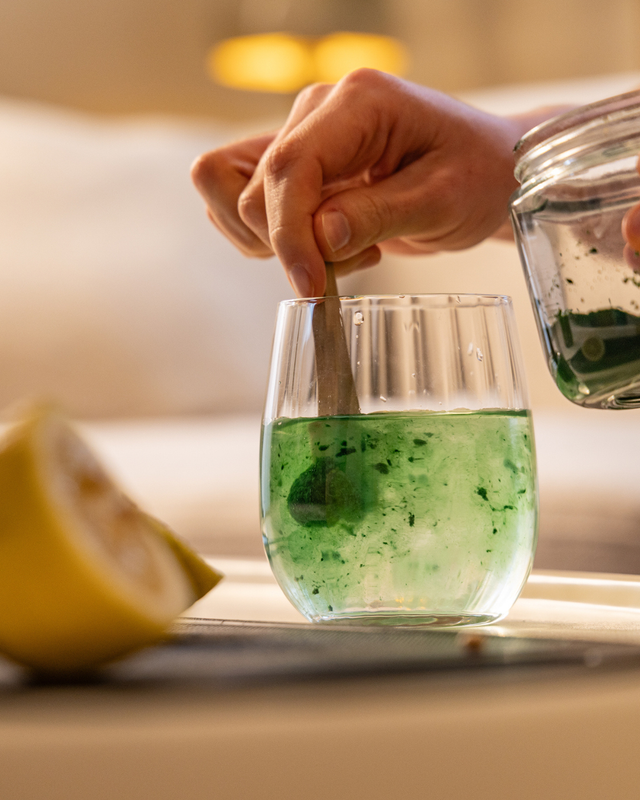
First, the berry smoothie: 15g fresh paste, raspberries or strawberries, a slice of lemon, oat milk. Vitamin C from the berries and lemon, no algae taste, ready in two minutes.
Second, salad with lemon dressing: Add spirulina paste directly over the finished salad and dress with lemon juice dressing. Dark leafy greens as a base increase the iron contribution of the entire meal.
Third, dip with bell pepper: Stir fresh paste into hummus or herbed cream cheese, eat with red bell pepper. Red bell pepper is one of the most vitamin C-rich vegetables available and provides significantly more than an orange.
If you want to know what your own harvest looks like and when the first portion is ready, you can find that on the page Harvesting Spirulina Correctly. And if you're just starting out and want to know what the journey from culture to first harvest looks like, you can find a complete guide in the article Growing Spirulina Yourself: From Unpacking to First Harvest in 14 Days.
Iron Deficiency Requires Medical Attention
This is non-negotiable.
Anyone with diagnosed iron deficiency needs a doctor, not an algae. A food cannot replace therapy. Anyone who claims otherwise is playing with the health of their readers.
Spirulina is not a medicine, a therapeutic, or a treatment. If you have symptoms that could indicate iron deficiency, get your blood checked. Self-diagnosing based on fatigue and an article on the internet is not a good idea. This sounds strict, but it's the only honest statement we can make here.
Building Block, Not Miracle Solution
For those who eat plant-based and want to ensure a broad iron supply, fresh spirulina is a valuable building block, alongside lentils, chickpeas, tofu, whole grains, pumpkin seeds, and dark leafy greens. However, it is not a substitute.
The honest number is smaller than the table promises. But it is real, and you can do something with it if you know how. Combined with vitamin C-rich foods, separated in time from coffee, as part of a varied diet, a daily portion of fresh spirulina paste makes a real contribution.
It's better to write the smaller, honest number and explain how to make more of it. That's the approach we take at MySpirulina, because trust is worth more than a grand promise.
If you want to grow fresh spirulina yourself and harvest portions directly from your windowsill, the MySpirulina Starter Kit is the obvious next step.
Frequently Asked Questions
How much iron is in a portion of fresh spirulina? In 15 grams of fresh paste, which is about 3 grams of dry matter, there is approximately 0.9 milligrams of iron. This corresponds to about five to eight percent of the daily requirement, depending on age and gender.
Can I meet my iron needs with spirulina? No. This would require amounts that a farm cannot provide and that no one would eat. Spirulina is a building block alongside legumes, whole grains, nuts, and dark leafy greens.
What improves iron absorption from plant-based foods? Mainly Vitamin C. Berries, lemon, bell pepper, or kiwi with the same meal make a significant difference. Coffee, black tea, and larger amounts of calcium inhibit absorption.
Is spirulina useful for diagnosed iron deficiency? A deficiency should be medically clarified and treated. A food does not replace therapy. Spirulina can then be part of a broadly based diet.
Does fresh spirulina contain more iron than powder? Not per gram of dry matter. Fresh paste consists mainly of water, so one gram of fresh paste contains less iron than one gram of powder. The difference lies in freshness, taste, and traceability of origin, not in iron content.