Spirulina Nutrients: What's Really Inside
And how much of it is lost during drying.
When I first looked into my own spirulina tank, my first thought was: "Is this supposed to be one of the most nutrient-dense foods in the world?" Murky green soup, slightly foamy, somehow alive. Not exactly appetizing. But that exact moment prompted me to take a more critical look at the nutritional promises surrounding spirulina. Because almost all guidebooks repeat the same impressive numbers without mentioning the factor that is actually decisive: it’s about how much of it is still there when you eat it.

What is actually inside
Spirulina is a blue-green alga, or more precisely a cyanobacterium, that has been intensively researched for decades. The nutrients are real and not invented. According to USDA FoodData Central, per 10 grams of dried spirulina powder, you get roughly:
- 6 to 7 grams of protein
- Significant amounts of iron (around 2.8 mg)
- Beta-carotene as a vitamin A precursor
- B vitamins such as B1, B2, and B3
- The blue pigment phycocyanin
- Chlorophyll
- Gamma-linolenic acid (GLA) as an essential fatty acid
- Minerals such as magnesium and potassium
Important to note: these figures almost exclusively refer to dried powder. That is the industry standard, and that is exactly what sets the context for everything that follows.
Spirulina protein content: justified or exaggerated?
The protein content of spirulina is about 60 to 70 percent by dry weight. Comparisons to meat appear everywhere, and yes, the numbers are impressive. But this percentage applies to the dry weight, and realistically, you only eat five to ten grams of powder daily. That amounts to four to seven grams of protein—not comparable gram for gram to a steak.
What actually makes spirulina interesting is its complete amino acid profile: all eight essential amino acids in one plant-based food. For vegan or vegetarian diets, this is definitely relevant, as nutritionist E.W. Becker confirmed in Biotechnology Advances (2007).
The blind spot: nutrient loss during drying
This is the chapter that powder suppliers prefer to leave out. A large part of the discussion about nutrient loss during drying is ignored by the industry because most providers only sell powder.
Spray drying and drum drying, the common industrial processes, operate at temperatures between 60 and over 200 degrees Celsius. Heat- and light-sensitive compounds suffer measurably as a result. Phycocyanin, the characteristic blue pigment and an intensively researched antioxidant, loses significant activity at temperatures above 60 degrees Celsius. Chaiklahan et al. (2011) show in Process Biochemistry that thermal drying leads to significant phycocyanin losses. Sensitive fatty acids such as GLA as well as certain enzymes and B vitamins are also partially degraded by heat.

Staying honest, however, also means: not everything is lost. Minerals are largely preserved, and the protein content remains structurally stable. But this exact distinction is missing from almost every guide.
Fresh spirulina vs. spirulina powder: what I have seen myself
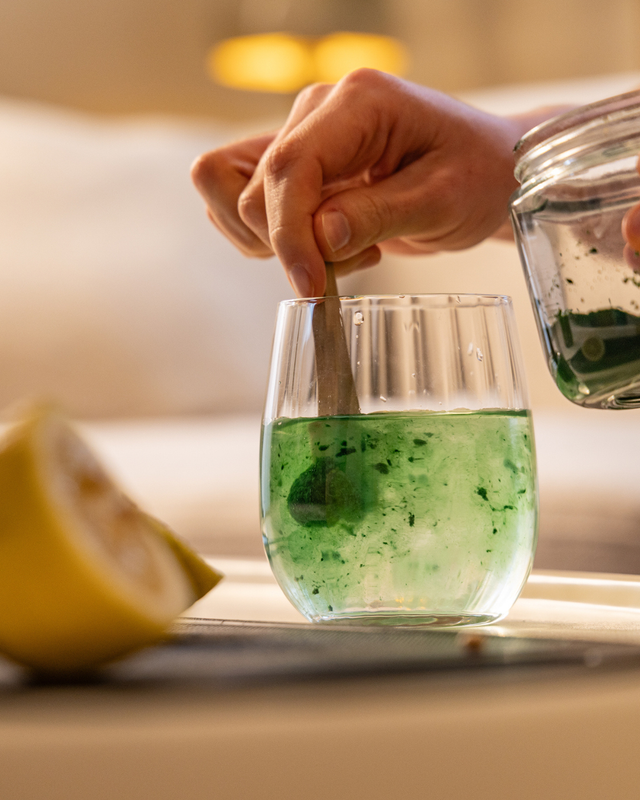
The difference between fresh and dried spirulina is not a marketing gimmick. You can notice it directly in the taste and texture. Freshly harvested spirulina tastes mild, almost neutral, and hardly "fishy-earthy." Spirulina powder, on the other hand, has an intense, for many unpleasant, characteristic taste that is hard to hide in smoothies. The consistency of fresh spirulina is creamy and can be easily stirred into water or yogurt.
Fresh: no heat stress from drying, full transparency regarding origin and processing, and you know exactly when it was harvested.
Powder: scores with long shelf life and immediate availability, but you often don't know how old it is, where it comes from, or how it was processed.
You can read about what home cultivation looks like in practice here: Growing superfood yourself: cultivating spirulina at home.
Spirulina and vitamin B12: the myth
Anyone who recommends spirulina as a B12 source for vegans is doing no one a favor. Spirulina primarily contains so-called pseudo-vitamin B12 analogues—compounds that look structurally similar but cannot be reliably utilized by the body. The German Nutrition Society (DGE) explicitly confirms this.
Spirulina is therefore not a reliable B12 supplier for vegans. Anyone following a plant-based diet still needs a verified B12 supplement. Addressing this doesn't weaken trust, it strengthens it.
Spirulina vs. Chlorella: different strengths
Chlorella is often mentioned in the same breath as spirulina. Chlorella has a hard cell wall that must be industrially broken down so the body can reach the nutrients at all. Spirulina does not have a cell wall in that sense and is considered easier to digest.
Chlorella scores with a very high chlorophyll content and is often discussed in the context of detoxification, though the body of evidence is mixed. Spirulina has a higher protein content and a more complete amino acid profile. Spirulina is also much better suited for fresh home cultivation because it is less complicated to grow. There is no "better" alga, only different areas of application.
How to get the most out of the nutrients
The most reliable way to get the most complete spirulina nutrients is to harvest the algae fresh instead of buying dried powder. No drying process, no storage time, no opaque supply chain.

The MySpirulina Starter Kit makes exactly that possible: you cultivate your own living source at home with a lab-tested spirulina culture produced in Germany. You harvest when the color is a vibrant green and stir the fresh harvest directly into your breakfast. The time required is about five minutes a day, with about 15 minutes for harvesting. Realistically, it takes a bit of effort, but that is exactly where the nutritional advantage lies.
Fresh nutrients, straight from your windowsill
With the MySpirulina Starter Kit, you harvest fresh spirulina at home—no drying, no detours, with a 30-day money-back guarantee.
To the Starter Kit