How Does Spirulina Taste? Fresh vs. Powder
What does Spirulina really taste like? Fresh and dried are two completely different things
"I don't like spirulina," are you sure you've ever tried it?
Most people who say they don't like spirulina have never tried spirulina. They have tried dried powder. This sounds like a quibble, but it isn't. The difference between fresh spirulina and the powder from the health food store is not a matter of taste preference, but of chemistry.
Spirulina is a cyanobacterium, colloquially a blue-green algae, that grows in warm water and has been intensively researched for decades. Not an exotic marketing invention, but a living microalgae with a genuine nutrient profile. And just like a herb from the garden, it tastes different fresh than dried.
By the end of this article, you'll know what fresh spirulina actually tastes like, why the powder smells like a fish pond, and what this difference has to do with industrial drying.
What does dried spirulina powder taste like, and why?
Honestly: fishy, earthy, sometimes musty. Anyone who stirs spirulina powder into a glass of water for the first time often thinks of pond sludge. This is no coincidence and not a quality defect of a particular manufacturer. It is a chemical byproduct of the drying process.
As long as spirulina is alive, its cells are intact. The delicate fatty acids, including gamma-linolenic acid, are enclosed and stable. During industrial drying, whether spray drying or drum drying, these cell walls rupture. The fatty acids meet oxygen and oxidize. This is precisely what creates the fishy, rancid note that so many people know and reject.
The fishy, rancid algae taste is not in the algae itself. It arises on the way to you, somewhere between the drying plant and the shelf. Freshly harvested, none of it can be tasted.
This is important to understand because it means: If you've tried spirulina powder and find it disgusting, you haven't tried spirulina. You've tried the oxidation product of a ruptured spirulina cell wall. That's a difference, and it explains why so many people prematurely write off the algae.
An overview of the drying of microalgae for human consumption (IntechOpen, 2019) describes the common methods and their effects on the quality of the finished powder. Spray drying and drum drying operate at temperatures between 60 and over 200 degrees Celsius. At these temperatures, oxidative changes are unavoidable. What ends up on the shelf is chemically different from what grew in the tank. We have written more about what happens to the individual nutrients during drying in fresh spirulina vs. powder.
What does fresh spirulina really taste like?
We didn't believe it ourselves until we harvested it fresh for the first time. A creamy, dark green paste came out of the filter, smelling of almost nothing. No pond, no fish, no mustiness. No one noticed it in yogurt. Not in smoothies either.
Fresh spirulina tastes mild, fresh and neutral. No fish, no bog, no aftertaste. Even stirred pure into water, it stays in the background.
In anything with its own flavor, i.e. in a berry smoothie, in natural yogurt, in a salad dressing, you don't taste it at all. That's the crucial point for everyday use.
The fresh paste is created immediately after harvesting. The algae is pressed through a fine filter to separate the water. Our guide to harvesting spirulina correctly shows how this works in practice. The texture is soft and creamy, the color a deep, rich green. Nothing about it resembles the powder from the can. Shelf life: around seven days in the refrigerator, freezable for longer periods.
Fresh and dried in direct comparison
Mild, fresh and neutral: that is how spirulina tastes when the cells stay intact. It never pushes to the front of a recipe and leaves the flavor of your ingredients as it is. With powder, the opposite is the case.
| Dried Powder | Fresh Spirulina Paste | |
|---|---|---|
| Smell | fishy, earthy | barely perceptible |
| Taste pure | strong and unpleasant | mild, fresh and neutral |
| In yogurt or smoothie | often still noticeable | cannot be tasted |
| Texture | dissolves poorly, clumps | creamy, can be stirred in |
Knowing this difference allows for a much more realistic decision on how to integrate spirulina into one's daily life. The direct comparison between fresh paste and powder, including nutritional aspects, is thoroughly described in fresh spirulina vs. powder.
Why the whole industry tries to hide the taste
It's remarkable how much effort the industry puts into masking the taste of spirulina. Capsules, flavorings, berry blends, ready-made shots with ginger and lemon. All of this is an attempt to hide a problem that arose during drying.
The capsule solution is the most honest variant: you simply swallow without tasting. But it doesn't solve the problem. It bypasses it. If you swallow spirulina capsules daily, you'll eventually wonder why, if you never truly experience the algae anyway.
Flavored powders go a step further. An oxidation product is covered with artificial or natural flavors so that the result tastes like a berry drink. This is not a solution for the algae taste. It's marketing over a manufacturing problem.
If the cells remain intact, the problem doesn't even arise. No flavors needed, no capsules, no tricks. An overview of the sensory properties of spirulina in Trends in Food Science & Technology (2025) summarizes which volatile compounds constitute the off-odor of spirulina and how they arise. What remains intact does not oxidize. What does not oxidize does not smell like a fish pond.
How you can try fresh spirulina, and what it goes best with
For beginners trying fresh spirulina for the first time, there are some combinations that work particularly well.
A berry smoothie is the classic: a handful of berries, banana, plant milk, and a tablespoon of fresh paste, i.e. around 15 grams. You taste the berries, the green color remains. Natural yogurt is the simplest option, just stir it in, and if you eat yogurt with a little honey or granola, you won't taste the spirulina. Even in a salad dressing made of olive oil, lemon, and mustard, a teaspoon of paste blends in without a trace.
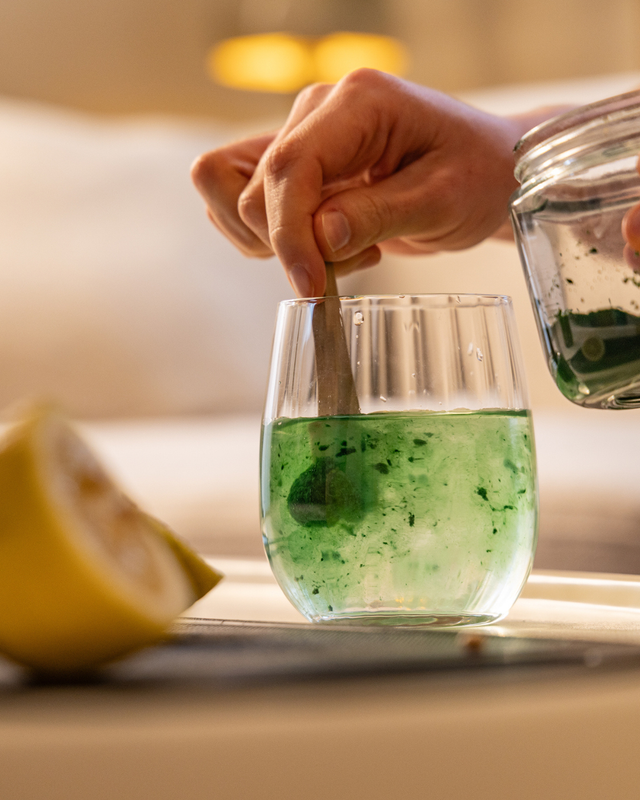
And then there's the honest counter-test: a teaspoon of fresh paste pure in a small glass of water with lemon, without anything else. This is the moment when you understand what mild truly means. No fish, no bog. What you taste is mostly the lemon.
The problem: You won't find fresh spirulina in the supermarket. It's too delicate for transport chains. Realistically, you grow it yourself, which is not rocket science. We describe how this works from unpacking to the first harvest in 14 days here step-by-step. The MySpirulina Starter Kit bundles everything for this: grow jar, LED light, air circulation, starter culture, nutrient salt, and harvesting aid, without any tinkering. The first harvest is realistic after ten to fourteen days, or even earlier under good conditions.
Frequently asked questions about the taste of spirulina
Does spirulina taste like fish? Dried powder often does. The tone arises when cell walls rupture during drying and fatty acids come into contact with oxygen. Freshly harvested spirulina does not taste fishy, but mild, fresh and neutral.
How do I get rid of the algae taste in the powder? Not completely. You can mask it with berries, lemon, ginger, cocoa, or nut butter, and the colder the drink, the less noticeable it is. However, the taste is inherent in the powder and cannot be eliminated.
What does fresh spirulina smell like? Hardly anything. The fresh paste has a subtle green, fresh smell. If it smells musty or distinctly unpleasant, the harvest is no longer good and should not be consumed.
Does chlorella taste different from spirulina? Yes. Chlorella is generally considered to be stronger and grassier, sometimes slightly bitter. Both are microalgae, but different organisms with different flavor profiles.
Can I eat fresh spirulina plain? Yes. Many stir it into water with a splash of lemon. It tastes mild, fresh and neutral. In yogurt, smoothies, or dressing you don't taste it at all.
If you've struggled with spirulina before, it wasn't your fault
If you've struggled with spirulina before, it was most likely not your fault and not the algae's fault. It was due to a processing step that happens between the living algae and your glass, and which hardly any manufacturer transparently explains.
Dried powder tastes fishy-earthy because cell walls have ruptured and fatty acids have oxidized. This is not a quality feature, but a drying artifact. Fresh spirulina paste tastes mild, fresh and neutral and cannot be tasted in recipes with their own flavors.
Anyone who truly wants to get to know spirulina should experience it fresh once, before chasing flavors or swallowing capsules. The algae itself is much more pleasant than its reputation suggests. And that reputation, as we have seen, is not its own. It belongs to the drying process.