Spirulina vs. Chlorella: A Fair Comparison
Spirulina or Chlorella: A fair comparison of two microalgae
Anyone who Googles "Spirulina or Chlorella" almost always gets the same answer: a table with two columns, a winner at the end, done. The problem with this approach: it answers the wrong question.
Spirulina and Chlorella are not two variants of the same thing. They are two completely different organisms that happen to both be small, green, and edible. One is a bacterium, the other is a true alga with a cell nucleus. That might sound academic at first, but it determines almost everything that follows: how well your body digests them, and whether you can ever get them fresh.
This article does not declare a winner. It explains how the two differ and points out the aspect that is simply missing from most comparisons.
Origin and biology: a species of bacterium and a true green alga
Spirulina, botanically more accurately called Arthrospira platensis, is not a plant in the true sense. It is a cyanobacterium, colloquially known as blue-green algae. Cyanobacteria do not have a true cell nucleus and are among the oldest living organisms on Earth. Under a microscope, Spirulina looks like fine, spirally twisted threads.
Chlorella, on the other hand, is a true, single-celled green alga with a cell nucleus; it is spherical and microscopic. Of the many Chlorella species, three are currently permitted for sale as food in the EU: Chlorella vulgaris, Chlorella luteoviridis, and Chlorella pyrenoidosa. They are not considered "novel foods" under the Novel Food Regulation because people were consuming them before 1997.
Two different biological kingdoms, two different cell structures. And it is precisely this cell structure that makes the difference that really counts in the end.
The difference hardly any table mentions: the cell wall
Chlorella has a rigid, multi-layered cell wall consisting of cellulose and chitin-like polymers, among other things. In 2023, a research group led by Ana Spínola showed in the journal Animals that untreated Chlorella cells only achieve about 35 percent protein digestibility in digestion tests. The human gut simply cannot break through this shell easily.
This is why Chlorella is almost never sold unprocessed. Manufacturers must mechanically break open the cell wall beforehand using ball mills, high-pressure homogenization, or ultrasound. A review article in the journal Biomass by Machado, Carvalho, and Pereira demonstrates how effective this is: air-dried Chlorella biomass achieves a digestibility coefficient of about 59 percent, while drum-dried biomass reaches up to 89 percent. For comparison: casein or egg are at around 95 percent.
On the packaging, you can identify this step by terms such as "broken cell wall" or "cracked cell wall." If this isn't mentioned anywhere, I would ask. Without this step, many nutrients simply remain trapped inside the cell.
Spirulina does not need this processing. As a cyanobacterium, it has no cellulose wall; the cell envelope is significantly softer and thinner. The consumer advice center summarizes it as follows: unlike microalgae like Chlorella, Spirulina has no cellulose walls, which allows the body to absorb the nutrients more easily. This is no minor detail. It determines everything else in this comparison.
What this means for fresh versus processed
The nature of the cell wall almost automatically dictates how you consume both algae in everyday life.
Spirulina can be harvested fresh and eaten directly by the spoonful because there is no hard shell in the way. We describe exactly what this looks like in detail in the article Growing your own Spirulina: From unboxing to the first harvest in 14 days. Anyone wanting to know why fresh paste differs so fundamentally in taste and structure from dried powder can find the details in the article Fresh Spirulina vs. powder: What is better?
Chlorella, on the other hand, is almost never available fresh on the market. A Chlorella farm for your windowsill would make little sense: even if you could cultivate it at home, you would then have to industrially process the harvested cells. Only then would your body be able to access the nutrients. This is not an equipment problem, but a biological boundary.
In the end, only one of the two algae remains that can be meaningfully used without an industrial processing step. This is not a judgment, but a fact that follows directly from cell biology.
Nutritional priorities in a fair comparison
Both microalgae provide complete proteins with all essential amino acids, as shown in a 2024 review article by Podgórska-Kryszczuk in the journal Molecules. After that, however, the similarities pretty much end.
Spirulina scores with an exceptionally high protein content of 55 to 70 percent of its dry mass, in addition to phycocyanin—the blue pigment complex characteristic of cyanobacteria like Spirulina—as well as a significant iron content. The market check report by the German consumer advice centers from February 2025 confirms protein levels of up to 70 percent for Spirulina.
Chlorella is in a similar range for protein at around 43 to 67 percent but stands out primarily for its chlorophyll content, which is significantly higher than that of Spirulina. It also contains omega-3 fatty acids, iron, and provitamin A. Those interested in the exact figures for Spirulina can find them without health claims on our page about ingredients.
Neither of the two algae is "better" here. They have different focuses, and which one is relevant to you depends on the rest of your diet.
The special case of Vitamin B12: Chlorella sometimes performs better here
We will remain honest at this point, even if it doesn't always play into the hands of our own offerings.
In Spirulina, vitamin B12 exists primarily as pseudovitamin B12, a form the body cannot utilize. Fumio Watanabe and his team demonstrated this as early as 1999, and subsequent analyses have confirmed the finding. Chlorella tends to perform better here: a study of 57 commercially available algae supplements found that some Chlorella products contained exclusively active, biologically usable B12, whereas inactive pseudovitamin B12 predominated in Spirulina powders.
The German Federal Institute for Risk Assessment remains cautious nonetheless and suggests a maximum daily amount of 25 micrograms for vitamin B12 supplements, against a recommended intake of about 4 to 5 micrograms. The Chemical and Veterinary Investigation Office (CVUA) in Stuttgart also expressly warns: Spirulina, AFA, and Chlorella are not reliable sources of vitamin B12. The levels fluctuate strongly from batch to batch.
Anyone eating a plant-based diet who wants to seriously clarify their B12 intake should not rely on any microalgae, regardless of which one. We have already addressed this in more detail in a separate article on Spirulina and vitamin B12.
Taste and everyday suitability
The differences in taste are clear, and anyone who has tried both immediately notices which one is in their glass.
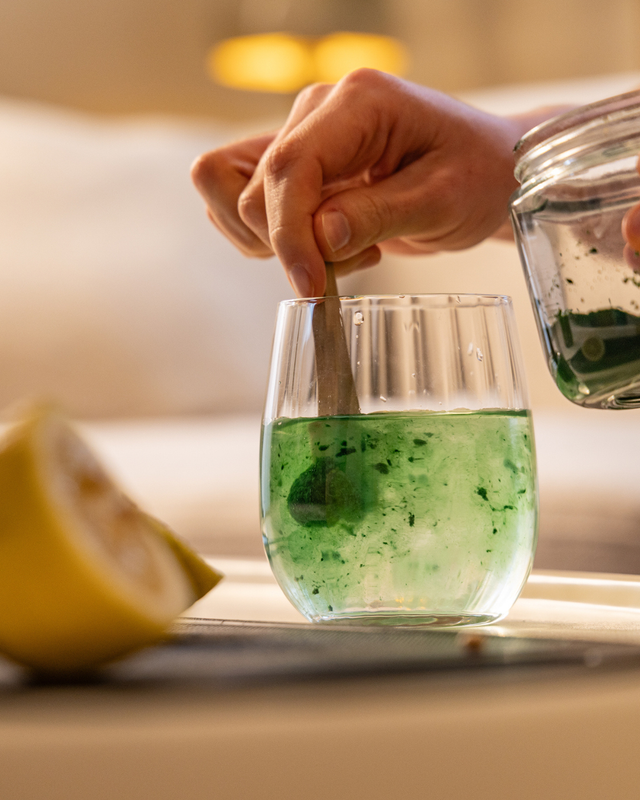
Chlorella tastes stronger, grassier, and often slightly bitter; there is also frequently a firm, slightly grainy texture, especially in powder form. Spirulina is milder. When harvested fresh—that is, raw and not dried—the typical algae taste disappears almost completely. The well-known, often criticized Spirulina flavor only develops during drying, when the cell walls rupture and fatty acids oxidize. We have written about why this is and what fresh Spirulina actually tastes like in What does Spirulina really taste like?
This is reflected in everyday use. Chlorella powder usually ends up in smoothies or juices because its flavor is otherwise too dominant. Fresh Spirulina paste, on the other hand, can be spooned pure, spread on bread, or stirred unobtrusively into dressings without you being able to taste it.
Comparison at a glance
Summarizing both, a clear picture emerges: Spirulina is a cyanobacterium with a soft cell wall that requires no processing, is mild in taste, and is actually available fresh, with a focus on protein, phycocyanin, and iron, but predominantly inactive B12. Chlorella is a true green alga with a rigid, cellulose-containing cell wall that must be industrially processed, is stronger and slightly bitter in taste, is practically never available fresh on the market, and has a focus on chlorophyll, omega-3, and provitamin A, but with partially active—albeit highly fluctuating—B12 content.
Conclusion: It's not about which algae is better, but what you want
What is bothersome about most comparisons online is the forced winner at the end. Two completely different organisms are pitted against each other like competing brands, and then one wins. This is misleading because it obscures the actual question.
The more sensible question is not which algae is better, but what you actually want. Do you want a high chlorophyll content and accept that you are necessarily buying industrially processed goods? Then Chlorella is a legitimate choice. Conversely, if you want as little processing as possible between harvest and plate, only one algae remains that can be sensibly cultivated yourself.
Anyone wanting to follow this path can find the starting point in the MySpirulina Starter Kit to harvest Spirulina fresh yourself, raw and without the detour through a factory. We answer further beginner questions about cultivation and the algae on our page with frequently asked questions.